
Our Lens
How we see
The way humans experience work, change, and complexity has shifted.
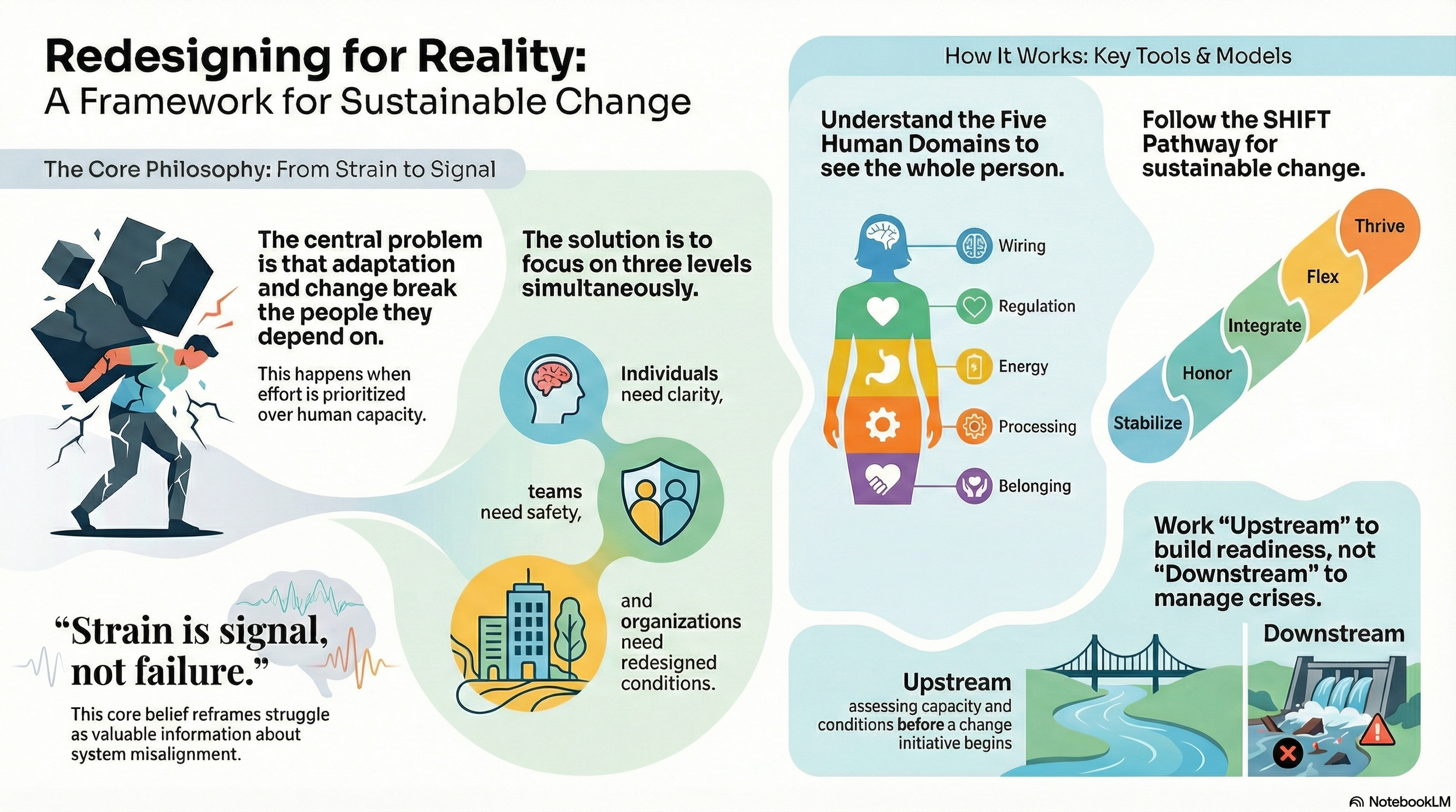
What many people are feeling is not confusion or resistance. It is the result of operating in systems that are asking more than human capacity can sustainably hold.
Our lens exists to name what is happening beneath the surface and to design for what humans actually need now.
The capacity gap
Most systems are designed as if humans have unlimited capacity.
They assume people can absorb constant change and adapt on demand. When strain appears, it is often misinterpreted as a performance or motivation issue.
Capacity is not effort.
Capacity is the biological and systemic ability to integrate what is being asked. When capacity is exceeded, clarity erodes, regulation becomes harder, and change does not land.
This is not a personal failure.
It is a design gap.
Why readiness comes first
Humans do not integrate change through pressure.
They integrate change when they are regulated, oriented, and able to make sense of what is happening. This state is readiness.
Readiness cannot be rushed. It emerges when stabilization is present and strain is reduced.
Without readiness:
Insight stays intellectual
Decisions feel reactive
Change does not sustain
Readiness is the condition that allows everything else to work.
How we apply this lens
The NeuroSpark+ Human Capacity & Readiness Lens is a capacity-first approach to working with humans under acceleration.
It is both how we see and how we work.
At its core, the lens asks one question:
Does this design restore or drain human capacity?
This lens is increasingly being used to evaluate tools and systems, including AI, that interact with humans under sustained pressure.
Our methodology brings together three essential elements that function in sequence.
Our sense-making foundation. It slows things down enough to see what is actually happening beneath pressure and restores clarity before action is required.
Root Reflection™
The Five Human Domains™
Wiring, Regulation, Energy, Processing, and Belonging. Capacity lives across these interconnected domains. Misalignment in any one drains the system.
Stabilize, Honor, Integrate, Flex, Thrive. This is how change is sequenced based on neurobiological readiness rather than urgency.
The SHIFT Pathway™
STABILIZE• HONOR • INTEGRATE • FLEX • THRIVE •
STABILIZE• HONOR • INTEGRATE • FLEX • THRIVE •
How this lens shapes our work
A few foundational truths guide every design decision.
Humans adapt neurobiologically, not aspirationally

Capacity is shaped by conditions, not character
Change must be supported by both humans and systems
Stability is precondition for progress
Neurodivergent realities reveal universal design truths
Sustainable change is staged, not forced
One system.
Different scales.
Human systems are fractal.
The same patterns that destabilize one person show up in teams, organizations, and communities. The scale changes. The human system does not.
Because of this, our lens applies across individuals, groups, and systems.
The handoff
Our role is to work upstream.
We make invisible strain visible, restore clarity, and establish readiness. Once readiness is present, individuals, teams, and organizations have the conditions to adapt sustainably.
Sustainable change cannot be imposed.
It integrates when humans have the capacity to engage it.