
Clarity, Capacity, and Change Under Acceleration (A Human Systems Map)
A Clear Pathway for Navigating Acceleration as a Human System
Context
This piece applies the NeuroSpark+ lens to what humans are experiencing under acceleration. It builds on the lived origin of this work and translates it into a shared orientation map that can be used by individuals, teams, and systems.
This is not a prescription or a strategy. It is a way of seeing what is happening beneath the surface, before deciding what to do next.
The same human patterns repeat across scales. The unit of analysis changes. The human system does not.
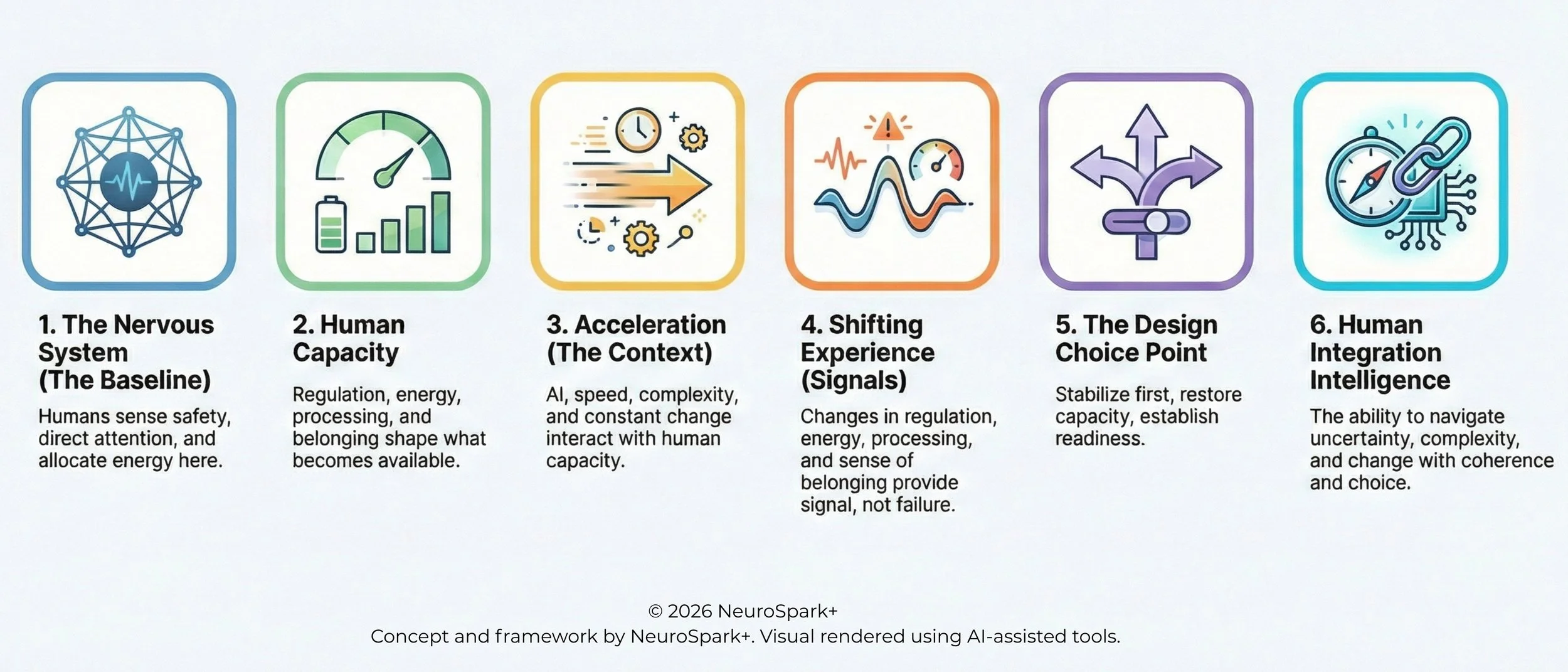
This pathway illustrates how humans move from nervous system baseline toward integration intelligence under acceleration.
This map reflects what I first lived personally before it had language, and what is now becoming visible collectively.
Something has shifted in how daily life feels.
Many people describe a constant sense of urgency. Always keeping up. Always adapting. Always holding more than feels reasonable. Even capable, thoughtful, motivated people find themselves stretched, scattered, or quietly exhausted.
This isn’t because you suddenly lost your edge.
It’s because the conditions around you changed.
What Actually Changed
The pace of life has accelerated.
Information arrives continuously. Decisions stack without pause. Expectations compress. Stimuli multiply. Very little has time to settle before the next demand appears.
AI didn’t create this. It revealed it.
Acceleration made visible something that had been building for some time. Our environments now ask more of humans than they were designed to hold. Not because humans are deficient, but because human systems have biological limits.
What many people are experiencing isn’t a single breaking point. It’s accumulation.
Layer upon layer of demand across thinking, emotions, relationships, and sensory input, without enough space to integrate or recover.
“When integration can’t happen, even ordinary life begins to feel heavier than it should.”
Why We Turn This Into Self-Blame
One of the hardest parts of this moment is how often the strain gets internalized.
People assume they should be managing better. They tell themselves to try harder, be more disciplined, build better habits, or optimize their mindset. Shame and self-doubt quietly replace understanding.
But nothing is wrong with the people feeling this.
Humans respond in predictable ways when pace exceeds capacity. Clarity drops. Energy fragments. Staying steady under pressure becomes harder. Life feels more effortful, even when you are doing everything “right.”
That response isn’t failure.
It’s signal.
For some people, especially those whose systems are highly attuned, this signal registers early. Not as panic, but as a quiet sense that something isn’t going to hold if conditions don’t change.
The Same Pattern, Everywhere
What shows up at the individual level shows up everywhere humans exist.
-
Constant adaptation without time to integrate
Masking to meet expectations, then crashing when alone
Doing all the “right things” and still feeling behind
Quiet self-blame about not keeping up
-
Constant compensation replacing sustainable support
Children adapting before systems do
Belonging becoming something you earn by behaving, coping, or performing
Exhaustion normalized as responsibility
Barriers to potential misread as personal or parenting failure
-
Celebrating intensity, compression, and last-minute heroics
Normalizing overwork as “just how things are”
Rewarding people for pushing through instead of stabilizing conditions
-
High turnover, disengagement, and people leaving without explanation AI tools adopted but not fully absorbed
Training that doesn’t change behavior
Change initiatives that stall before taking root
Leaders wondering why nothing seems to stick
“These are not separate problems. They are the same human system responding to the same condition at different scales.”
Same human biology. Different context.
What differs is not the human system itself, but how much integration work individuals are forced to absorb privately when systems don’t hold it collectively.

How I Came to See This
I didn't arrive at this understanding through theory. I arrived through lived necessity.
Years ago, what I was navigating as a parent made invisible barriers impossible to ignore. The same dynamics of masking, overload, and capacity collapse I was learning to recognize at home were showing up everywhere else. In workplaces. In teams. Across entire industries.
That proximity didn't make me exceptional. It made the pattern impossible to ignore.
What began as personal survival slowly became collective sense-making. Over time, this became a way of helping others see where barriers to their potential are concentrating, without having to learn it through strain.
Once the pattern becomes visible, it's hard to unsee.
Why This Moment Matters
This is an inflection point, not a collapse.
This is not a call to push harder or optimize humans further. It is an invitation to reorient around capacity before introducing more change.
Individual coping strategies can’t keep pace with systemic acceleration. Adding more tools, more training, or more pressure to already strained humans doesn’t restore capacity. It often backfires. Nothing integrates when there is no capacity left to hold it.
What’s needed now isn’t urgency.
It’s orientation.
Orientation begins with understanding the human nervous system as the baseline for capacity, experience, and change.
Stabilization comes before change.
Capacity comes before readiness.
And readiness is what allows more human decisions to be made under pressure.
Humans have always adapted. What needs to change now are the conditions that require people to bend, contort, and perform in ways that disconnect them from themselves just to function.
“This is a rare moment to design change differently, with human capacity treated as a prerequisite rather than an afterthought.”
The NeuroSpark+ Lens
This article introduces the NeuroSpark+ Lens Blog. A space focused on how humans regain capacity and readiness under acceleration.
Not by pushing harder. By stabilizing the conditions that allow clarity to return.
This lens isn’t about fixing people or optimizing performance. It’s about making barriers to potential visible, without blame, so capacity can return and real choice becomes available again.
Through this lens, I’ll explore:
How capacity is quietly drained
Why familiar solutions stop landing under acceleration
How stabilizing conditions changes everything that follows
“Seen early, barriers to potential become signal rather than cost.”
The pieces that follow translate this lens into ways people and systems can begin restoring capacity, without self-blame and without waiting for breakdown. This is what enables Human Integration Intelligence to emerge.
