
Designing for Human Capacity in an Accelerating World (Signals from PCMA)
What PCMA Convening Leaders Made Visible

This TLDR captures the sequence of signals I observed at PCMA, and what they reveal about designing experiences people can integrate and carry forward.
This is what the NeuroSpark+ lens looks like applied: seeing where barriers concentrate, noticing what becomes possible when conditions support capacity, and asking better questions about what we're designing for.
Before arriving, I shared that I wasn’t attending to evaluate individual sessions, speakers, or production value.
I was paying attention to something else.
I was tracking early signals of human integration: how much capacity people had available to actually receive what was happening, before effort or engagement were asked of them.
How people arrived.
How information was delivered.
How energy moved through the space.
And whether the environment helped people integrate what they were experiencing, or required ongoing self-management just to get through the day.
This is the sequence in which clarity emerged.
The Opening Signal: How Content Was Designed
The first signal appeared early, in the structure of the opening keynote.
Three speakers. Shorter segments. Followed by a moderated conversation.
That design choice reflected an understanding that attention fluctuates. Processing is not linear. Integration depends on variation, not volume.
What becomes visible, again and again, is that information saturation rarely produces insight. More often, it produces cognitive congestion.
This wasn’t about preference or trend. It reflected how human nervous systems tend to process information under sustained demand.
That early choice set the tone.
What I Named in My Session
Later in the program, I spoke in a session where I wanted to name something that is often present but rarely acknowledged.
That nervous systems do not arrive at events with a clean slate.
I asked three simple questions.
Who got sick over the holidays and is still recovering?
Who experienced stress or disruption related to family, travel, or logistics?
And who feels uncertainty, anxiety, or cognitive load about what this year may bring?
Every person in the room raised their hand.
That moment didn’t reveal fragility. It revealed baseline conditions.
Baseline conditions are where integration either becomes possible or begins to erode. When they’re ignored, humans compensate quietly. When they’re acknowledged, more human decisions become available.
It made visible the state many people are already carrying before a single slide appears.
This is the lens I work from.
I’m often described as a neuroinclusion voice in this industry. That’s accurate to a point. But the way I use a neurodiversity-informed lens is not about designing for a small subset of people.
It’s about noticing where strain registers first.
Neurodivergent nervous systems often detect overload earlier and more precisely. This is a form of anticipatory capacity sensing. Neurodivergent nervous systems often register environmental mismatch sooner, not because they are fragile, but because they are accurately responding to conditions that will eventually affect everyone.
That makes neurodivergent experience an early signal.
When that signal is followed upstream, it points toward pacing. Infrastructure. Information flow. And how much integration humans are being asked to do without adequate support.
In my work, neuroinclusion functions as a gateway. It opens visibility into human capacity more broadly.
“Neurodivergent experience isn’t an edge case. It’s an early signal.”
And if this is the condition many people are arriving in, then engagement and connection are shaped less by content quality alone and more by how much capacity is available at the point of arrival.
“Engagement is often shaped less by content quality and more by how much capacity people have when they arrive.”
How the Environment Reflected That Reality
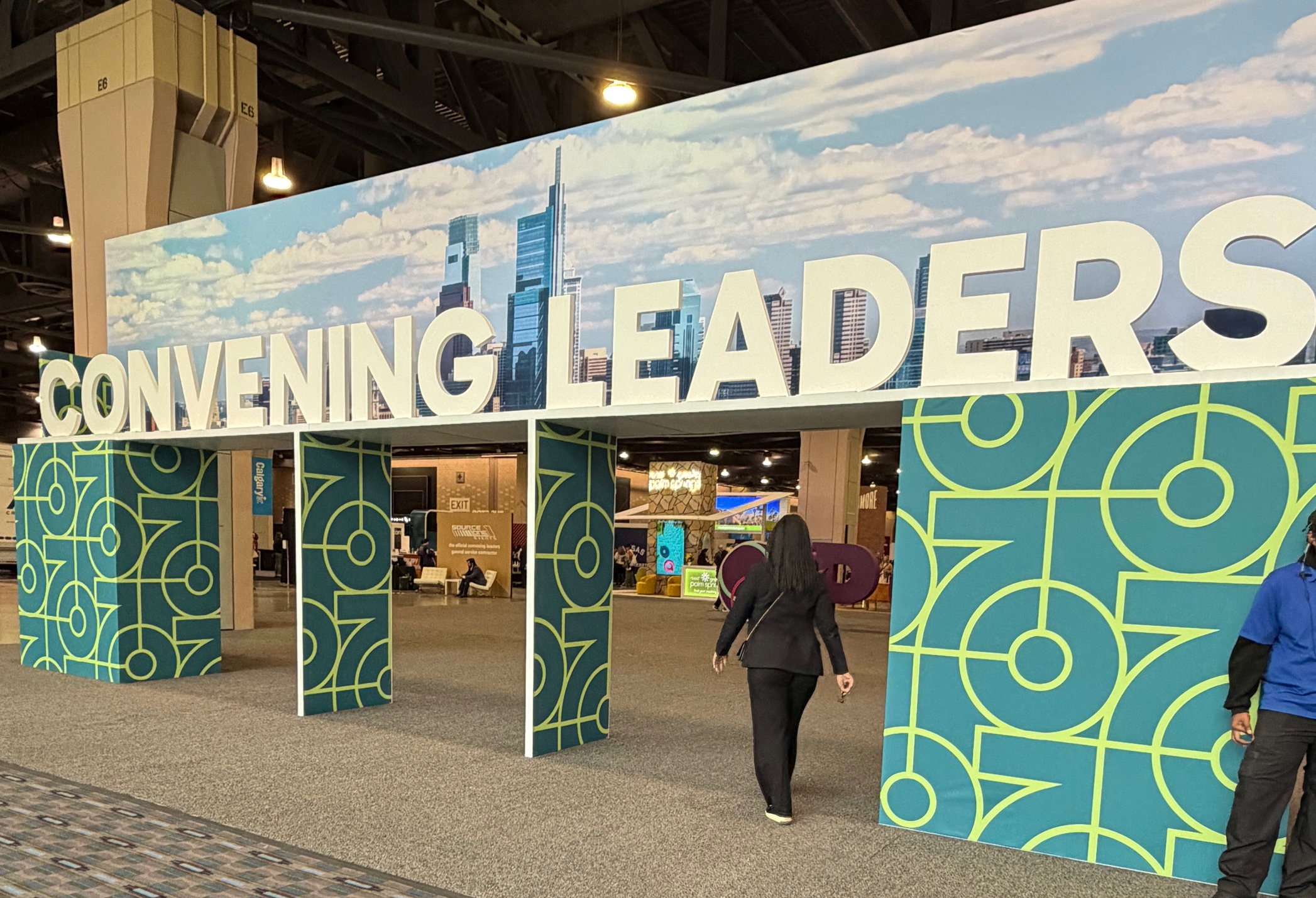
As the conference unfolded, another signal became clear.
Parts of the environment already seemed to understand this.
In The District, several spaces reflected an orientation toward regulation and integration rather than activation alone.
Two booths in particular supported capacity across the domains I tend to notice: wiring, regulation, energy, processing, and belonging.
They did so without requiring explanation.
Marriott International gave their entire booth entirely to Safe Expo.
Rather than product demos, Matthew Laws designed this space to intentionally support nervous system restoration.
Compression boots.
Automatic shoulder and foot massages.
Customized essential oils.
Soft blankets.
Comfortable seating.
It created a place where people could reset without leaving the event.
People lingered. They returned. Conversations slowed.
By supporting regulation, the space made sustained presence more accessible over time.
Nearby, Caesars Entertainment created a similarly intentional environment.
A calming VR experience friendly for those who are sensitive to motion, managed by David Stevens
A sensory integration space focused on grounding, designed by Rachel Milford
Small tactile elements people could carry with them.
Fresh smoothies and nourishing food options.
These were the spaces I noticed myself returning to.
Not as a strategy. As a response.
Through Safe Expo and the Caesars activations, regulation, energy, processing, and belonging were supported without instruction.
Nothing in these environments required constant self-management to participate.
Presence became easier.
What stood out was that this wasn’t wellness positioned as a side offering.
It was capacity support built directly into the experience.
Where Connection Became Possible
As the days progressed, another pattern emerged.
The most meaningful conversations didn’t arise from structured networking or prompts. They emerged where there was enough spaciousness for people to actually arrive.
Conversations slowed. Listening deepened. Performance dropped away.
People stayed longer.
What stood out was that many of these conversations occurred in the very spaces designed to reduce pressure.
When the environment supported regulation, connection followed.
Not because anyone tried harder. Because capacity was available.
When nervous systems aren’t preoccupied with managing overload, attention becomes accessible. When attention is accessible, conversation changes.
This is easy to miss when engagement is discussed only through metrics.
Connection cannot be demanded or optimized. It becomes possible when conditions allow.
At PCMACL, connection functioned as a signal.
It indicated that human capacity had been considered.
The Closing Signal: What’s the Point?
The final signal arrived at the close of the conference.
Trevor Noah didn’t just deliver a compelling keynote. He asked a question that felt deeply aligned with everything I had been observing throughout the week.
What’s the point?
He spoke about communication not as what is intended, but as what is received. About how assumptions rush in when clarity is missing. And about the responsibility leaders carry to create conditions where people feel safe enough to ask questions instead of pretending they understand.
What lingered most was where he placed his attention when speaking about change and technology.
Not only on whether progress eventually works out. But on what happens in the meantime.
The stretch where systems move faster than humans can integrate.
Where people absorb transition strain before outcomes stabilize.
Where some advance, while others quietly carry the cost.
His optimism about AI was grounded and pragmatic. We may figure things out over time.
The more immediate question is who is supported while that figuring-out is underway.
One example he shared landed simply.
Henry Ford paid his employees enough to afford the cars they were building.
Otherwise, what was the point?
If events exhaust the humans they are meant to serve, what’s the point? If organizations accelerate change without integration capacity, what’s the point?
These questions don’t halt progress. They orient it.

Why This Matters Now
What this experience reinforced is that designing for human capacity is not about lowering standards or resisting change.
It’s about creating conditions where complexity can actually land.
When I left PCMACL, I noticed something simple.
I didn’t leave depleted.
I left integrated.
That outcome is rarely accidental. It reflects deliberate design choices that treat human capacity as foundational rather than optional.
Neuroinclusion is often what makes this visible first.
Not because neurodivergent people are exceptions, but because their nervous systems register strain earlier.
Events amplify these signals quickly.
They compress time. They concentrate demand.
“Events reveal, in days, what organizations often discover months or years later.”
That gives this industry a particular vantage point.
When people disengage, leave early, cluster in certain spaces, or avoid others, that isn’t preference. It’s information about how the environment is functioning.
When pacing, regulation, and integration are designed in, engagement tends to emerge without force.
Those outcomes reflect design choices.
And design choices reflect leadership.
If we keep asking what the point is, and if human capacity remains part of that answer, events don’t just respond to acceleration.
They help shape how change is carried.
Not by doing more.
By designing conditions that humans can actually integrate, while there is still room to adjust.
The most pressing question isn’t whether we’ll figure things out eventually.
It’s what happens in the interim.
