
What Travel Makes Visible
On human capacity, designed environments, and what leaving home allows you to see
I am not looking for perfection. I am looking for friction.
That is what travel has become for our family. Not escape. Not adventure for its own sake. A way of seeing clearly. A clean slate that strips away the adaptations we have layered over years at home, and lets me watch what my children actually need when the variables are reset.
Both of my sons are neurodivergent. In our daily life, I cannot always tell what belongs to their wiring and what belongs to the environment. The two have been braided together for so long they are hard to separate.
Travel separates them.
In our daily life, they are asked, constantly and quietly, to adapt. To fit their nervous systems into environments designed for a different kind of wiring. That compensation rarely looks dramatic. It is the accumulated cost of a thousand small adjustments made every day just to function.
When you are a traveler, you are not supposed to fit in. Nobody expects you to. The foreignness is the point. And in that release, something becomes visible that daily life keeps hidden. I can see what steadies my children and what unsettles them. I can see what they have been quietly compensating for.
Japan did not teach me something new. It gave me language for what I already knew how to see.
I have spent twenty years designing environments for other humans. Travel is where that lens sharpens, because it removes the layer of adaptation that daily life builds up.
Before We Arrived
Travel itself is not neutral. Airports, security lines, abrupt time changes, crowded boarding processes, unfamiliar food. For many neurodivergent families, the journey is the hardest part.
We do not leave that to chance.
The week before departure, we simplify schedules and prioritize sleep. We begin shifting circadian rhythms before crossing time zones. At the airport, we use programs that reduce unpredictability and allow us to move through security and board early. We bring familiar food and sensory tools. When we land, the first days are adjustment days. We allow the nervous system to settle before asking anything of it.
I share this not as a guide, but as a way of seeing.
Each of those choices exists for a reason. The standard travel experience assumes a nervous system that can absorb abrupt transitions without consequence. Many cannot.
What I see, consistently, is the relationship between what an experience asks and what a person can sustainably hold.
When demand exceeds capacity, even the most extraordinary destination can become something to endure rather than receive.
We do not prepare because our children cannot handle the world. We prepare because capacity is shaped by conditions. And conditions can either support or strain what is already there.
When the journey is stabilized, the destination has a chance to offer itself fully.
When the Environment Holds the Order
Tokyo should overwhelm a sensitive nervous system. It is dense, vertical, and in constant motion.
Yet within hours, I felt my own vigilance soften.
Passengers lined up in marked positions on the subway platform without instruction. On escalators, people stood to one side and left space for others to pass. Once inside the train, voices lowered automatically. Movement had rhythm.
I had prepared my children for this. I expected effort. I expected reminders.
They were not needed.
They stood quietly. They did not scan the train car. They mirrored the room.
Children learn regulation through what is modeled for them. They co-regulate with what surrounds them. In Tokyo, the cues were steady. The room carried the rhythm first, and they followed.
Shared rhythm reduces cognitive load. When the environment holds more of the order, individuals do not have to generate it themselves. The constant background work of scanning, adjusting, and anticipating begins to quiet. I could feel that shift in my children almost immediately.
We saw children no older than six riding the subway alone. Small backpacks. Quiet confidence. No visible alarm from the adults around them. In a city this large, dense, and populated, the sight startled me. I had expected vigilance. Instead, I felt something closer to trust.
Safety was not announced. It was assumed. And that assumption changes how a body moves.
That pattern extended beyond transit.
Where we stayed, popular restaurants lined nearly every block. By any logic, it should have been loud. It was not. We went to bed early and woke early. The silence was almost disorienting in the best way. Not empty. Quiet in a way that felt intentional.
I normally travel with noise-canceling headphones to sleep. I did not need them here.
Convenience stores offered warm meals, vegetables, fruit, and protein. Eating on the go did not require compromise. We did not have to override hunger cues because healthy options were simply available.
Vending machines offering hot and cold drinks appeared on nearly every block. Hydration was assumed.
Public restrooms were clean and accessible. Heated seats were standard. Bidets were integrated. These are small things until you notice how much energy it takes to brace against discomfort throughout a day.
Within the first few days, I began to feel what had been quietly accumulating. Not because something had been added, but because something had been removed.
—-
What I Was Carrying Without Realizing
But it was not only my children.
It was also me.
At home, there is a constant layer running in the background. I am thinking about water, about food, about bathrooms, about what might be needed next and whether it will be available when it is.
These are not dramatic concerns. They are basic human needs. And yet they travel with me everywhere, quietly and continuously.
In Japan, much of that disappeared.
Water was always available. Food did not require planning. Bathrooms were clean and predictable.
I was not managing the environment.
The environment was holding us. It had already anticipated what we would need.
I noticed I had stopped scanning ahead. The energy I usually spend anticipating, preparing, and compensating was no longer required. It returned, not as relief alone, but as usable capacity.
Capacity to be present. Capacity to notice my children in ways that are harder to access when part of me is always scanning ahead. Capacity to respond instead of manage.
I had not realized how much I was carrying until I was no longer carrying it.
At home, I cannot always tell whether the strain we experience comes from who we are or from what we are navigating. In Japan, that distinction sharpened. When the environment absorbed more of the load, capacity became easier to access.
What I see in my children is not unique to them. A more sensitive nervous system simply makes the pattern easier to notice. It reveals something that applies far more broadly.
Five Centuries of Intentional Design
I pay attention to how experiences and spaces either overload or steady the people inside them, and what that reveals about what those spaces are asking of the people inside them.
Walking through Tokyo, I found myself tracing this quality back five centuries.
In the sixteenth century, tea master Sen no Rikyū refined a ceremony structured around preparation before arrival. The garden path was designed to slow the pace. Stepping stones required attention. The entrance required the body to lower itself. Inside, light was soft and materials were natural.
Nothing was accidental. It was intentional.
The body was given time to arrive. The senses were not overwhelmed. Attention was gently directed. Energy was conserved. The space signaled how to be. Every element worked together to reduce excess demand.
Long before we had language for nervous system regulation, understanding was embedded in how environments were shaped.
That philosophy did not remain confined to tea rooms. It scaled into daily life. The intentional pause. The anticipation of need. The idea that care is built into structure rather than added afterward.
Tokyo and Kyoto express it differently. One coordinates. The other contains. The surface changes. The underlying principle — that environments should carry more of the load than the people inside them — does not.
A Different Kind of Steady
Kyoto arrived first as sensory overload. The scale of the station, the volume, the movement. We moved through it quickly and stepped out into something entirely different.
The streets were narrow and quiet. Not empty, but contained. Our lodging sat on one of Kyoto’s traditional streets and something in us began to settle almost immediately.
We visited everything early. The bamboo forest before the crowds arrived is not a travel tip. It is a nervous system strategy. In the early morning, the path is quiet enough that you can hear the bamboo move. My children did not need to be told to slow down. The space slowed them.
At Ryoan-ji, we sat in front of the zen garden longer than we had planned. Fifteen stones in raked gravel. Nothing to solve. Nothing to interpret. The longer we sat, the quieter we became. My children lingered without being asked. I have learned to trust that signal. It means a space is doing something right.
What works for the most sensitive nervous system in the room almost always works better for everyone in the room.
At several temples we were asked to remove our shoes before entering. That simple act created a threshold. The body registered that this space was different. That something had been prepared.
There was another practice that stayed with me long after we left. Goshuin books. At each temple, a monk brushes calligraphy by hand and stamps a seal specific to that place and that day. It exists because you stood there.
Most souvenirs are consumed or shelved. A goshuin records that you were received. It continues to carry the experience after you return home.
In a culture where so much care is built into structure, even memory is designed to say: you were here, and it mattered.
Midway through our final days, my younger son developed acute viral gastroenteritis. Plans dissolved. We stayed in. We slowed further.
The Shinkansen back to Tokyo was smooth and punctual. Bathrooms were spacious and immaculate. Staff were available, though no contact was necessary. The environment did not demand anything of us. Everything simply functioned.
This is what it looks like when a space absorbs demand before it hits the nervous system.
For children who spend most of their days in environments asking something of them, an environment that simply functions around them — without demanding anything in return — is not a small thing.
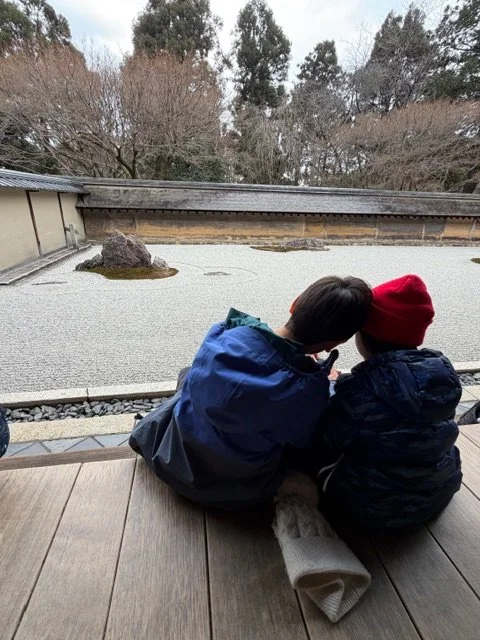
Ryoan-ji zen garden
The Difference He Felt Immediately
We had already landed back home when my son told me what he missed.
He missed how clean Japan was. He missed that it did not smell. He missed the warm toilet seats.
Within hours of returning, his body registered what had shifted.
For two weeks, he had not needed to brace in the same way. He had not needed to override small discomforts at every turn. Nothing about that difference was dramatic. It was cumulative.
In Japan, much of the friction had been absorbed before it reached him. Coming home required picking it back up.
This is not about comparing cultures. It is about noticing what lifts when expectations change, and what returns when those conditions are no longer there.
What Travel Reveals
Travel, for us, is not about escape. It is about calibration.
It gave me a way to see what happens when expectations reset and pressure redistributes. In a new environment, patterns sharpen. I can feel what steadies my children and what quietly asks them to compensate.
The mirror works in both directions.
Travel did not just show me Japan. It showed me what I had stopped seeing at home.
Clarity does not begin with judgment. It begins with seeing.
When my son spoke in that airport bathroom, he was not offering a sentimental reflection. He was describing the difference between a body that had softened and a body that had resumed bracing.
I have learned to trust those signals.
You do not have to be neurodivergent to feel this shift. You just have to pay attention long enough to notice it.
Since that trip, it has been harder not to notice what environments ask people to carry quietly. I see more clearly who expands under certain conditions and who contracts.
What looks like a people problem is almost always a conditions problem. And conditions can be changed.
That is true in classrooms. In workplaces. In the rooms where we gather thousands of humans and assume their capacity will simply be there. Often without ever examining what those environments are asking the people inside them to carry.
Travel makes those patterns harder to ignore.
That is why we go.
This is the pattern I have spent years learning to see — through lived experience, through the five domains that shape human capacity, and through twenty years of designing environments for other humans. Japan didn't give me the lens. It gave me enough distance from my day to day to see it more clearly, and a way to show it to others.
It is also what Capacity Reflection™ was built to make visible. A place to begin seeing your own conditions clearly. Free, always.
